 (1)__largepreview__.webp)
DID JESUS CONDONE SLAVERY?
QUESTION:
My friend said Jesus condoned slavery in Luke 12:47. And he said that's why the Church condoned it for many centuries too.
ANSWER:
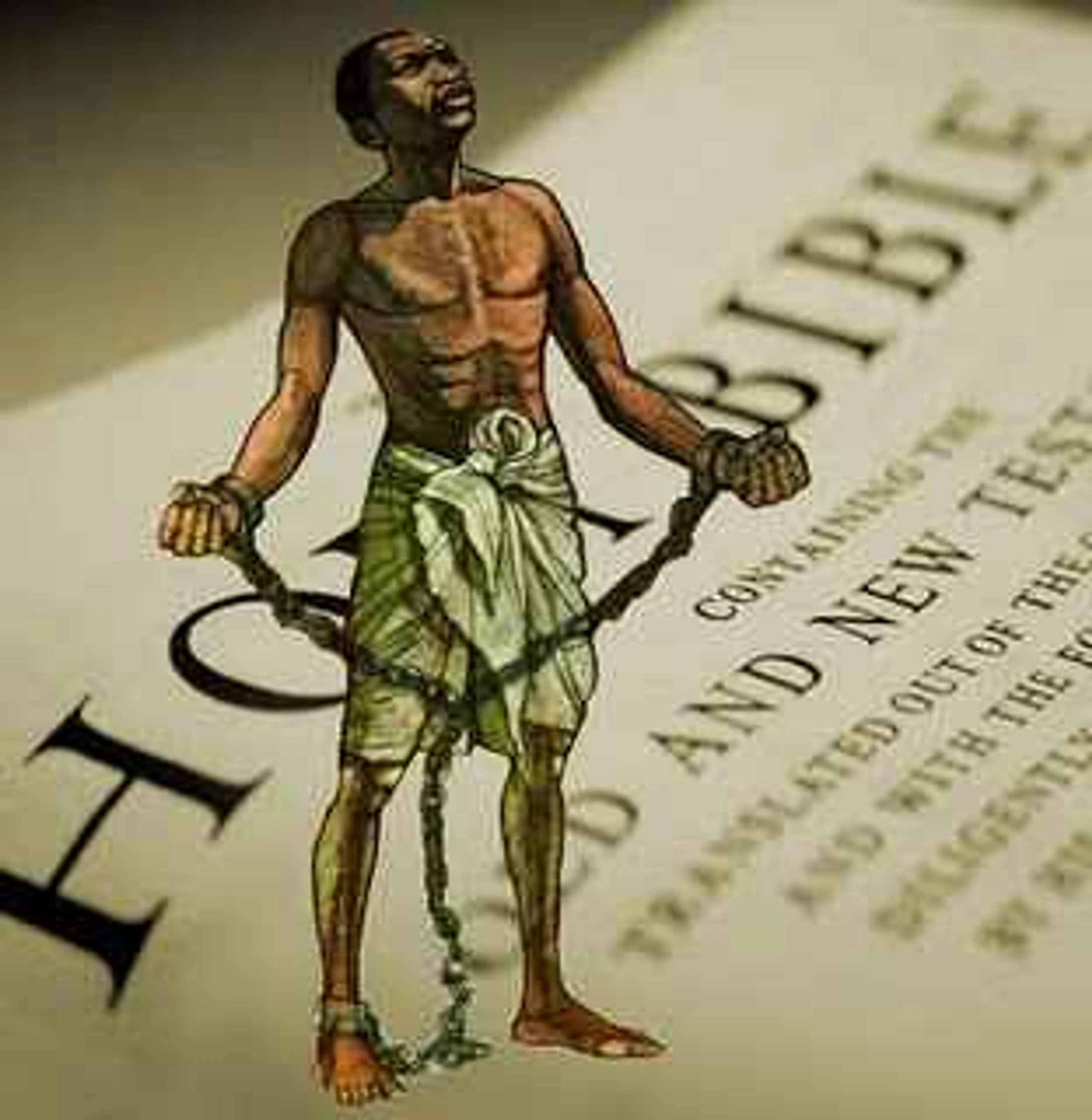
No, Jesus never condoned slavery. He doesn't address the institution from a moral perspective at all, except that he talks about slaves in his stories. This is the case in Luke 12:47.
THE WORD "DOULOS"
The Greek word in question in this verse is "doulos" which means literally "slave." It referred to an individual who was owned by someone else. So the word would have implied people as property to the original audience. However, there are many things that using the the word "doulos" would not have implied to the original audience that the word "slave" would imply to a modern audience.
This is why most translations of Luke 12:47 do not use the word "slave" but rather the word "servant."
So some critics will point to this move by translators to argue that they are softpeddling the Bible's implicit endorsement of slavery, meaning, race-based chattel slavery, slave trading, human trafficking and systemic abuse. But it is precisely because the original audience would not have associated "doulos" with those things that the word "slave" is rarely used to translate it.
JESUS APPROVES SLAVERY: AN ARGUMENT FROM SILENCE
Some may still make the argument that because Jesus' culture was so defined by the institution of slavery, that this lack of teaching on or condemnation of it constitutes condoning or approval by Jesus. But this is an argument from silence. Such arguments are very flimsy. We can make Jesus condone child abuse, spousal abuse, and incest if we insist that what he never commented on, he must have approved of.
So we must do the work to understand how "slavery" was understood and practiced in Jesus' time, so that we are not guilty of importing modern ideas into the text - leading to such facile notions as "Jesus condoned slavery."
NOT ALL SLAVERY CREATED EQUAL
In fact, slavery in the ancient world was not what we moderns often assume. Our impressions of slavery have mostly been formed by slavery as practiced in the United States. As we know, the American slave trade was sustained by racist premises. Alexander Stephens, the Vice President of the Confederacy, famously declared:
- "Our new government is founded upon... the great truth that the negro is not equal to the white man; that slavery subordination to the superior race is his natural and normal condition."
SLAVERY IN THE BIBLE
In contrast, Biblical slavery, even from Moses' time, was mostly economic. You became a slave if your people were conquered in war, so as an alternative to killing all the conquered, they would become the property of the victor instead. This was considered (by both sides) just “booty” - a reward for winning a conflict.
But a much more common form of slavery was indentured servitude, which was when you sold yourself into slavery to pay unpayable debts. As an alternative to death or prison, you could give the only thing you had left – your labor, permanently.
Now, because slavery in Bible times was a tool of economic “justice” mostly, you could buy your way out of it, or a relative could free you from it. And in Israel, for Jewish slaves, there was this startling development: God said slave status would never last for more than 7 years, because in the Sabbath year, all slaves were freed.
For this reason we shouldn’t be too aghast that the Bible doesn’t come forward with stronger condemnations of slavery.
THE DIFFERENCES
First, it was not built on racist ideology.
Second, it wasn’t a life sentence, as it was for every black in America, who, no matter what ransom they might be able to give to their masters, could never be free. Laws were instituted that if a slave escaped to the North, they had to be returned, and if a Northern black came to the South, his free status was not honored.
Third, slavery was checked by putting an upper limit on the value of slave labor – instead of saying a debtor must sell himself in perpetuity, the Sabbath and Jubilee years said, no debt is worth a lifetime of servitude. Essentially, then, human value got elevated in the Law since a person was too valuable to keep in slave-status forever. No debt was worth that much.
Fourth, the Mosaic law always seems to be taming slavery, putting limits on masters, which essentially gave slaves rights (Ex 21:8-11)! To some, when God gives laws about slavery, it seems that he’s condoning it. In actuality, he’s beginning the process of ending it! We must always keep in mind that slavery wasn’t invented in God's Law – the institution pre-exists the Law. Humans were probably the first economic good ever traded between human groups. So the Law was imposed over such articles of human depravity, and therefore, it seems to contain it, limiting its abuses - even if it doesn’t abolish it in one move.
JESUS' STORY ABOUT A "SLAVE"
Then Jesus shows up and tells this story about a slave in Luke 12. But if you read the story carefully, the "slave" is anything but a minion, destined to serve because of racial inferiority. The slave is actually a household manager, with other servants under him, and, after showing great responsibility, stands to inherit the estate! These kinds of "slaves "were well known in Jesus' time.
One may point out that in this story, Jesus said, if this household manager is irresponsible, he will suffer and be beaten (Luke 12:47). But that's not an endorsement of the abuses of slavery, but rather reflective of the cultural attitude toward corporal punishment. Back then, beating was a common punishment for crimes committed by freemen and slaves. To this day, many non-Western cultures use beatings for misdemeanors in lieu of fines or prison time.
Our focus in this passage, then, should shift from the stigma of slavery to Jesus' central lesson on spiritual responsibility.
THE IMPACT OF JESUS ON SLAVERY
If we would like to assess the impact of Jesus' life and teaching on slavery, it begins here:
He declares that his kingdom is for the poor and oppressed to set them free (Luke 4:18). This was first understood in a spiritual sense, and thus slaves flocked to the early church. Why, if there was no guarantee of emancipation? Because there, under the teaching of Jesus, they were taught that while they were someone else’s property, in Christ, they were free. If they could gain their freedom, they should, but to always keep in mind that their future was the kingdom of heaven. They were loved by God and adopted into this family.
Masters, conversely, were also in the church and they were told to love their slaves, not treat them harshly, but fairly and like brothers. And to remember that they were Christ’s slaves (Eph 6:9, Col 4:1). In fact, in one case, a Master (Philemon) is told to forgive and (we presume) free a runaway slave (Onesimus) because this slave is a brother. This is incredible! How could Masters and Slaves be brothers in the same churches? This teaching forecasted the end of the institution of slavery, with such radical ideas at the center of the New Community.
WHY NO DIRECT CONDEMNATION OF SLAVERY?
You could say the apostles should have been more direct in their condemnation of slavery. But I would say their approach was much shrewder, and therefore more effective. They attacked the values upon which slavery was based. So, without imposing a ban on slavery from a position of ecclesiastical authority, a ban which may have hopelessly divided a very young church and derailed her from her primary mission in the world, Paul undermines the whole institution with words such as, “there is no longer slave nor free, for you are all one in Christ… and "Masters, serve your slaves as brothers." (Gal. 3:28; Eph. 6:7-9, Philemon)
SLAVERY THROUGH CHURCH HISTORY
As a result of such earth-shattering ideas, slavery did, in fact, die out; first in the Church where Christians benefactors were often known to redeem slaves. As the Church expanded, slavery withered. Nowhere else on planet Earth did this happen. Not in China, not in the Middle East under Islam, not in Africa (where blacks enslaved blacks for millennia), not in India.
During the so-called Dark Ages, slavery became almost unheard of in Europe. However, there were millions of white slaves taken by Muslim hordes to Arabia. In fact, we get our word “slave” from those millions of men and women, mostly Slavs, taken from Slovakia and other places in Eastern Europe.
Not until the other races of Africa and America were discovered did slavery rise again in Christendom. But voices in the Church railed against it. You hear about Christian military men, governors, and explorers who were avid slave traders. But remember how rampant nominalism was in the Church in those times. Literally everyone in Europe was baptized Christian- what percentage were truly devout and committed to the implications of Jesus' teaching in all life? Meanwhile, the really devoted Christians, the Dominican monks, the Jesuits, and the papacy, through repeated edicts, railed against Slavery. Thus, it advanced despite real Christians, not because of them.
CHRISTIAN JUSTIFICATIONS FOR SLAVERY
So the economy of Europe quickly became dependent on the slave trade, and all sorts of Christian justifications ensued. But these reasons were ridiculous. For example, the use of the prophecy against Ham in Genesis. Or the New Testament rule for slaves to submit to masters. The hypocrisy and deliberate blindness of these lines of reasoning were self-evident for anyone who took Scripture sincerely.
Ask yourself, if it truly was the Bible, clearly understood and applied, that gave backing and justification for American slavery, why were the Scriptural rules allowing for the freeing of slaves never invoked for the black man? Why was the repeated explicit biblical condemnation of slave trading (literally "man-stealing") not binding on the conscience of these Christians? If man-stealing ended, in obedience to this repeated Scripture command (Ex 21:16; 1 Tim 1:10), slavery would have been over in one generation.
NO JUSTIFICATION IN JESUS FOR SLAVERY
Any objective critic will see that there is no justification in Jesus for chattel slavery. There is only one real reason, which has been repeatedly exposed in the laws and writings of the time: It wasn’t the Bible, it was the evil of racist ideology. Black men were assumed to be inferior.
The hard truth is that even some emancipation fighters from the Northern States (including Lincoln!) had a hard time believing the African was in any way his equal. This particularly odious idea could never have come from a Bible that repeatedly declares that humans are all genetically linked to the same first parents, establishing our fraternity and equality forever.
(This idea did, however, find a natural home in Darwin's theory.)
SLAVERY ENDED BY CHRISTIANS
So finally, it was the Church again, by Papal Bull in the South Americas, and under the names of devout Christians like Wilberforce and Evangelicals in the Northern States, who understood the full force of God’s Word regarding human dignity and value and equality, who led the way to abolish the slave trade and eventually emancipate all slaves. Every historian acknowledges the debt the world owes to the Evangelical church in England and the Northern states for leading the way for abolition.
LINCOLN'S VIEW
When Lincoln gives his second inaugural address, we see the primary authority he believed undergirded the grim work of forcing emancipation on the whole Country, was the Bible. Did he think that Jesus (or Scripture overall) condoned slavery? Obviously not.
- "Woe unto the world because of offenses; for it must needs be that offenses come, but woe to that man by whom the offense cometh."
- If we shall suppose that American slavery is one of those offenses which, in the providence of God, must needs come, but which, having continued through His appointed time, He now wills to remove, and that He gives to both North and South this terrible war as the woe due to those by whom the offense came, shall we discern therein any departure from those divine attributes which the believers in a living God always ascribe to Him?
- Fondly do we hope, fervently do we pray, that this mighty scourge of war may speedily pass away. Yet, if God wills that it continue until all the wealth piled by the bondsman's two hundred and fifty years of unrequited toil shall be sunk, and until every drop of blood drawn with the lash shall be paid by another drawn with the sword, as was said three thousand years ago, so still it must be said "the judgments of the Lord are true and righteous altogether."
- Abraham Lincoln - 2nd Inagural Address